WifiScan Development Guide_Rev1.1
Revision History
Version |
Date |
Author |
Revision Content |
|---|---|---|---|
Rev1.0 |
2023-09-12 |
WTY |
Initial document creation |
Rev1.1 |
2024-03-25 |
sxx |
Changed document name |
1 Introduction
This document introduces the LTE-EC71X Wifi Scan interface APIs. The API interfaces are declared in the file components/kernel/lierda_api/liot_wifiscan/liot_wifiscan.h.
New
2 API Function Overview
Function |
Description |
|---|---|
|
Enable Wi-Fi Scan |
|
Disable Wi-Fi Scan |
|
Configure Wi-Fi Scan parameters |
|
Perform Wi-Fi Scan synchronous mode scanning |
|
Start Wi-Fi Scan asynchronous mode scanning |
|
Register callback function |
Note:
Unless otherwise specified, the Wi-Fi Scan API interface functions mentioned in this document do not support concurrent calls, and cannot be called in any callback function, otherwise it will affect the processing of subsequent messages.
It is not supported to enable Wi-Fi Scan when doing data services on LTE network.
3 Type Descriptions
3.1 liot_wifiscan_errcode_e
Wi-Fi Scan error code definition enumeration is as follows:
Declaration
typedef enum
{
    LIOT_WIFISCAN_SUCCESS = 0,
    LIOT_WIFISCAN_EXECUTE_ERR = 1 | LIOT_WIFISCAN_ERRCODE_BASE,
    LIOT_WIFISCAN_MEM_ADDR_NULL_ERR,
    LIOT_WIFISCAN_INVALID_PARAM_ERR,
    LIOT_WIFISCAN_SEMAPHORE_WAIT_ERR,
    LIOT_WIFISCAN_MUTEX_TIMEOUT_ERR,
    LIOT_WIFISCAN_OPEN_FAIL,
    LIOT_WIFISCAN_BUSY_ERR,
    LIOT_WIFISCAN_ALREADY_OPEN_ERR,
    LIOT_WIFISCAN_NOT_OPEN_ERR,
    LIOT_WIFISCAN_HW_OCCUPIED_ERR,
    LIOT_WIFISCAN_NO_SET_CB_ERR,
} liot_wifiscan_errcode_e;
Parameters
LIOT_WIFISCAN_SUCCESS: Execution successful
LIOT_WIFISCAN_EXECUTE_ERR: Execution failed
LIOT_WIFISCAN_MEM_ADDR_NULL_ERR: Memory allocation failed
LIOT_WIFISCAN_INVALID_PARAM_ERR: Invalid parameter
LIOT_WIFISCAN_SEMAPHORE_WAIT_ERR: Semaphore wait exception
LIOT_WIFISCAN_MUTEX_TIMEOUT_ERR: Mutex acquisition exception
LIOT_WIFISCAN_OPEN_FAIL: Wi-Fi Scan enable exception
LIOT_WIFISCAN_BUSY_ERR: Wi-Fi Scan repeated enable error
LIOT_WIFISCAN_ALREADY_OPEN_ERR: Wi-Fi Scan not enabled
LIOT_WIFISCAN_NOT_OPEN_ERR: Wi-Fi Scan busy (such as scanning in progress)
LIOT_WIFISCAN_HW_OCCUPIED_ERR: Hardware occupied
LIOT_WIFISCAN_NO_SET_CB_ERR: Callback function not set
3.2 liot_wifi_ap_info_s
Scanned Wi-Fi AP specific information structure definition is as follows:
Declaration
typedef struct
{
    UINT8 bssidNum; // rssi number
    UINT8 rsvd;
    UINT8 ssidHexLen[LIOT_WIFI_SCAN_MAX_AP_CNT];  // the length of Wifi SSID Name hex data
    UINT8 ssidHex[LIOT_WIFI_SCAN_MAX_AP_CNT][32]; // the hex data of WiFi SSID Name
    INT8 rssi[LIOT_WIFI_SCAN_MAX_AP_CNT];         // rssi value of scanned bssid
    UINT8 channel[LIOT_WIFI_SCAN_MAX_AP_CNT]; // record channel index of bssid, 2412MHz ~ 2472MHz corresponding to 1 ~ 13
    UINT8 bssid[LIOT_WIFI_SCAN_MAX_AP_CNT][6]; // mac address is fixed to 6 digits
} liot_wifi_ap_info_s;
Parameters
bssidNum: Number of scanned WIFI APs
rsvd: Reserved parameter
ssidHexLen: SSID length
ssidHex: SSID data
rssi: AP signal strength
channel: WIFI AP channel
bssid: WIFI AP MAC address
3.3 liot_wifiscan_callback
Wi-Fi Scan callback function pointer definition is as follows:
Declaration
typedef void (*liot_wifiscan_callback)(liot_wifiscan_ind_msg_s *msg_buf);
3.4 liot_wifiscan_ind_msg_s
Kernel notification information structure definition to APP side through callback function is as follows:
Declaration
typedef struct
{
    uint32_t msg_err_code;
    void *msg_data;
} liot_wifiscan_ind_msg_s;
Parameters
msg_err_code: Execution result code, please refer to section 3.1.
msg_data: Specific notification data, can be converted to liot_wifi_ap_info_s type structure to read data
4 API Function Details
4.1 liot_wifiscan_open
This function is used to enable Wi-Fi Scan.
Declaration
liot_wifiscan_errcode_e liot_wifiscan_open(void);
Parameters
None
Return Value
liot_wifiscan_errcode_e: Execution result code, please refer to section 3.1.
4.2 liot_wifiscan_close
This function is used to disable Wi-Fi Scan.
Declaration
liot_wifiscan_errcode_e liot_wifiscan_close(void);
Parameters
None
Return Value
liot_wifiscan_errcode_e: Execution result code, please refer to section 3.1.
4.3 liot_wifiscan_option_set
This function is used to configure Wi-Fi Scan scanning parameters.
Declaration
liot_wifiscan_errcode_e liot_wifiscan_option_set(int32 maxTimeOut,
                                                uint8 round,
                                                uint8 maxBssidNum,
                                                uint8 scanTimeOut,
                                                uint8 wifiPriority);
Parameters
maxTimeOut: [In] If there is no scan result after timeout, an error will be reported, range: 4000 ~ 255000, default value: 12000, unit: milliseconds;
round: [In] Number of Wi-Fi Scan rounds, range: 1~3, default value: 1;
maxBssidNum: [In] Expected number of Wi-Fi hotspots to be scanned, range: 4~10, default value: 5;
scanTimeOut: [In] Wi-Fi Scan RRC polling timeout, range: 0~255, default value: 5, unit: seconds;
wifiPriority: [In] Wi-Fi Scan priority parameter, 0: data priority, 1: Wi-Fi Scan priority. (Note: In data priority mode, wifi scanning will only start when CFUN=0 or UE is in IDLE state; In Wi-Fi Scan priority mode, if UE is in connected state, regardless of whether there is data service, it will interrupt the current connected state and return to idle to initiate wifi network search)
Return Value
liot_wifiscan_errcode_e: Execution result code, please refer to section 3.1.
4.4 liot_wifiscan_do
This function is used to perform Wi-Fi Scan synchronous mode scanning.
Declaration
liot_wifiscan_errcode_e liot_wifiscan_do(liot_wifi_ap_info_s *p_ap_infos);
Parameters
p_ap_infos: [Out] Information of all scanned APs. See 3.2 liot_wifi_ap_info_s for details.
Return Value
liot_wifiscan_errcode_e: Execution result code, please refer to section 3.1.
4.5 liot_wifiscan_register_cb
This function is used to register Wifi-Scan asynchronous mode callback function.
Declaration
liot_wifiscan_errcode_e liot_wifiscan_register_cb(liot_wifiscan_callback wifiscan_cb);
Parameters
wifiscan_cb: [In] Interrupt callback function, which will be entered when scanning is completed after calling the asynchronous scanning function. Callback function format see 3.3 liot_wifiscan_callback
Return Value
liot_wifiscan_errcode_e: Execution result code, please refer to section 3.1.
4.6 liot_wifiscan_async
This function is used to start Wi-Fi Scan asynchronous mode scanning.
Declaration
liot_wifiscan_errcode_e liot_wifiscan_async(void);
Parameters
None
Return Value
liot_wifiscan_errcode_e: Execution result code, please refer to section 3.1.
5 Code Example
Sample code reference: examples/demo/src/demo_wifiscan.c file.
#include <stdio.h>
#include <stdlib.h>
#include <string.h>

#include "lierda_app_main.h"
#include "liot_os.h"
#include "liot_type.h"
#include "liot_wifiscan.h"

/*===========================================================================
 * Functions
 ===========================================================================*/
void liot_wifiscan_ap_info_output(liot_wifi_ap_info_s *p_ap_infos)
{
    if (NULL == p_ap_infos)
    {
        return;
        liot_trace("result NULL");
    }

    for (uint16 i = 0; i < p_ap_infos->bssidNum; i++)
    {
        liot_trace("WIFISCAN:(-,-,%d,\"%02X:%02X:%02X:%02X:%02X:%02X\",%d",
                   p_ap_infos->rssi[i],
                   p_ap_infos->bssid[i][0],
                   p_ap_infos->bssid[i][1],
                   p_ap_infos->bssid[i][2],
                   p_ap_infos->bssid[i][3],
                   p_ap_infos->bssid[i][4],
                   p_ap_infos->bssid[i][5],
                   p_ap_infos->channel[i]);
    }
}

// all memory of msg_buf and it's sub item will be released by core after the call of callback.
void liot_wifiscan_app_callback(liot_wifiscan_ind_msg_s *msg_buf)
{
    liot_wifiscan_close();

    if ((LIOT_WIFISCAN_SUCCESS == msg_buf->msg_err_code) && (NULL != msg_buf->msg_data))
    {
        liot_wifi_ap_info_s *scan_result = msg_buf->msg_data;
        liot_trace("ap_cnt=%d", scan_result->bssidNum);
        liot_wifiscan_ap_info_output(scan_result);
    }
}

// to start a async scan
void liot_wifiscan_async_start(void)
{
    if (LIOT_WIFISCAN_SUCCESS != liot_wifiscan_option_set(LIOT_WIFI_SCAN_TIME_VAL_DEF,
                                                          LIOT_WIFI_SCAN_DEFAULT_ROUND,
                                                          LIOT_WIFI_SCAN_DEFAULT_AP_CNT,
                                                          LIOT_WIFI_SCAN_SCANTIMEOUT_VAL_DEF,
                                                          LIOT_WIFI_SCAN_PRIORITY_VAL_DEF)

    )
    {
        liot_trace("option set err");
        return;
    }
    if (LIOT_WIFISCAN_SUCCESS != liot_wifiscan_register_cb(liot_wifiscan_app_callback))
    {
        liot_trace("register cb err");
        return;
    }
    if (LIOT_WIFISCAN_SUCCESS != liot_wifiscan_open())
    {
        liot_trace("device open err");
        return;
    }
    if (LIOT_WIFISCAN_SUCCESS != liot_wifiscan_async())
    {
        liot_wifiscan_close();
        liot_trace("to do a async scan err");
        return;
    }
}

// complete flow to do one time scan: option->open->scan->close->output
void liot_wifiscan_synchro_complete_flow(void)
{
    if (LIOT_WIFISCAN_SUCCESS != liot_wifiscan_option_set(LIOT_WIFI_SCAN_TIME_VAL_DEF,
                                                          LIOT_WIFI_SCAN_DEFAULT_ROUND,
                                                          LIOT_WIFI_SCAN_DEFAULT_AP_CNT,
                                                          LIOT_WIFI_SCAN_SCANTIMEOUT_VAL_DEF,
                                                          LIOT_WIFI_SCAN_PRIORITY_VAL_DEF))
    {
        liot_trace("option set err");
        return;
    }

    if (LIOT_WIFISCAN_SUCCESS != liot_wifiscan_open())
    {
        liot_trace("device open err");
        return;
    }

    liot_wifi_ap_info_s ap_infos = {0};

    if (LIOT_WIFISCAN_SUCCESS != liot_wifiscan_do(&ap_infos))
    {
        liot_wifiscan_close();
        liot_trace("to do a scan err");
        return;
    }

    liot_trace("ap_cnt=%d", ap_infos.bssidNum);
    liot_wifiscan_close();
    liot_wifiscan_ap_info_output(&ap_infos);
}

void liot_wifiscan_demo_thread(void *argv)
{
    liot_trace("==========wifiscandemo start==========");
    liot_rtos_task_sleep_ms(1000);
    while (1)
    {
        liot_wifiscan_synchro_complete_flow();
        liot_rtos_task_sleep_ms(5000);
        liot_wifiscan_async_start();
        liot_rtos_task_sleep_ms(15000);
    }
}
Running Result:
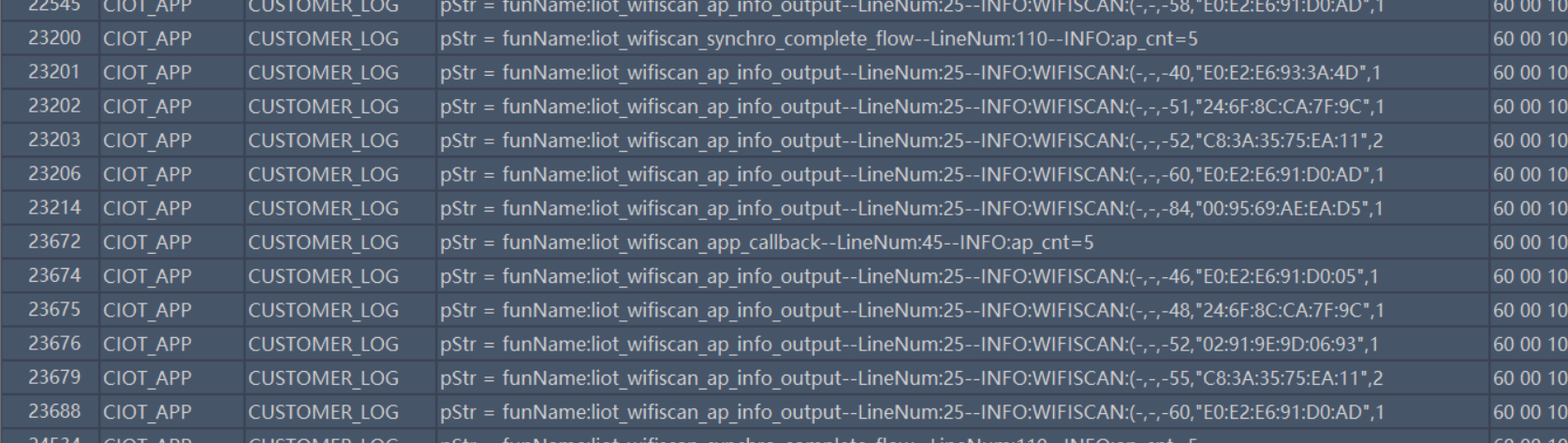
As shown in the figure above, it indicates that all information has been obtained normally.