SOCKET Development Guide_Rev1.1
Revision History
Version |
Date |
Author |
Reviewer |
Revision Content |
|---|---|---|---|---|
Rev1.0 |
2026-01-23 |
zw |
zlc |
Initial document creation |
Rev1.1 |
2026-03-27 |
zw |
zlc |
Optimized document content |
1 Overview
This document introduces the LTE-EC71X SOCKET2 interface APIs. The usage flow can refer to the following flowchart.
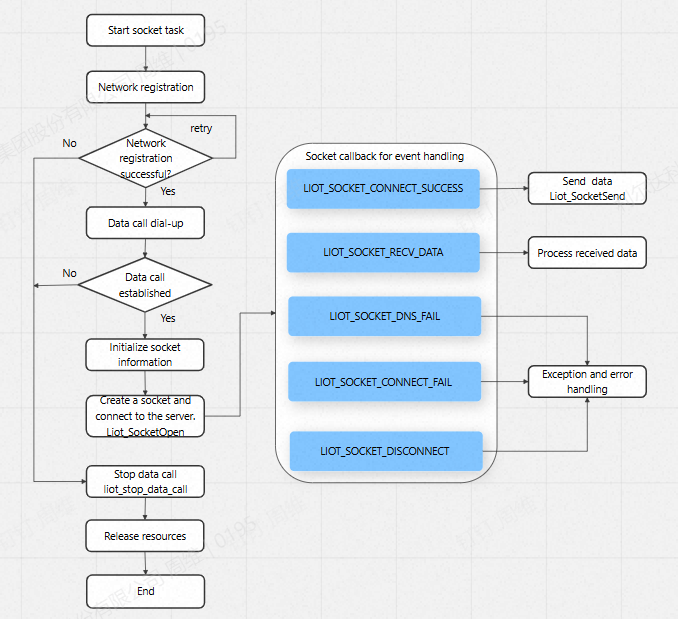
The above process is the Socket communication flow based on cellular network Cat1 module, mainly including initialization, network registration, data call, Socket connection establishment, data transmission and exception handling. The specific process is as follows:
SOCKET task startup: Program starts executing Socket communication task.
Network registration:
Check whether successfully registered to cellular network.
If registration fails, loop waiting or retry until registration succeeds.
Data Call:
After successful network registration, initiate data call to establish PS domain data connection.
If dial-up fails, stop and release resources, process ends; if successful, continue to next step.
Initialize Socket information: Prepare parameters required for Socket communication (such as server address, port, etc.).
Create Socket and connect to server: Call Liot_SocketOpen to create Socket and try to connect to server. Connection result is notified asynchronously through callback function.
Callback event handling: Handle according to different callback events:
LIOT_SOCKET_CONNECT_SUCCESS: Connection successful, enter data send/receive phase.
LIOT_SOCKET_RECV_DATA: Receive data from server, perform business processing.
LIOT_SOCKET_DNS_FAIL: Domain name resolution failed, trigger exception handling.
LIOT_SOCKET_CONNECT_FAIL: Failed to connect to server, trigger exception handling.
LIOT_SOCKET_DISCONNECT: Connection disconnected, trigger exception handling.
Data send/receive:
After successful connection, can send data to server through Liot_SocketSend interface.
When receiving data, handle in LIOT_SOCKET_RECV_DATA event.
Exception error handling: When exceptions such as DNS failure, connection failure or disconnection occur, enter exception handling process, stop data call, release resources, and end task.
Normal termination: When communication completes or exits abnormally, call liot_stop_data_call interface to stop data call, release related resources, process ends.
The entire process adopts asynchronous callback mechanism to ensure that network registration, data call and Socket connection execute in sequence, and has exception recovery capability.
2 API Function Overview
Function |
Description |
|---|---|
|
Create Socket connection and connect to server |
|
Send socket data |
|
Get current status of socket |
|
Close socket |
3 Type Descriptions
3.1 Liot_SocketEvent_e
Enumeration definition:
typedef enum
{
    LIOT_SOCKET_CONNECT_SUCCESS = 0,
    LIOT_SOCKET_DNS_FAIL = 1,
    LIOT_SOCKET_CONNECT_FAIL = 2,
    LIOT_SOCKET_RECV_DATA = 3,
    LIOT_SOCKET_DISCONNECT = 4,
}Liot_SocketEvent_e;
Enumeration description
Variable |
Description |
|---|---|
LIOT_SOCKET_CONNECT_SUCCESS |
Connect to server successfully event |
LIOT_SOCKET_DNS_FAIL |
DNS resolution failed event |
LIOT_SOCKET_CONNECT_FAIL |
Connect to server failed event |
LIOT_SOCKET_RECV_DATA |
Receive data event |
LIOT_SOCKET_DISCONNECT |
Disconnect from server event |
3.2 Liot_Socket_Type_e
Enumeration definition:
typedef enum
{
    LIOT_SOCKET_TYPE_TCP = 0,
    LIOT_SOCKET_TYPE_UDP = 1,
}Liot_Socket_Type_e;
Enumeration description
Variable |
Description |
|---|---|
LIOT_SOCKET_TYPE_TCP |
Socket connection type is TCP |
LIOT_SOCKET_TYPE_UDP |
Socket connection type is UDP |
3.3 Liot_SocketInfo_t
Structure definition:
typedef struct
{
    int socket_fd;          // socket fd 0-7
    uint8_t cid;            // cid 0-7
    uint8_t socket_type;    //TCP UDP
    uint8_t host[256];      //host name domain or IP
    uint16_t port;          //port number
    uint16_t local_port;    //local port
    int32_t keepidle;       //heartbeat detection interval
    int32_t keepinterval;   //heartbeat detection interval
    int32_t keepcount;      //heartbeat detection count
}Liot_SocketInfo_t;
Structure variable description
Variable |
Description |
|---|---|
socket_fd |
Socket file descriptor. Output parameter, valid after socket creation succeeds |
cid |
cid 0-7. Network dial-up channel number, usually default use CID 1. Input parameter |
socket_type |
TCP: LIOT_SOCKET_TYPE_TCP |
host |
host name domain or IP. Input parameter |
port |
Server port number. Input parameter |
local_port |
Local port number. Input parameter |
keepidle |
How long after connection idle to start probing. Unit: seconds. Range: between 1 and 0x7FFFFFFF (2,147,483,647) seconds, 0 is default value 7200 seconds (2 hours). Input parameter |
keepinterval |
Time interval between heartbeat probe packets. Unit: seconds. Input parameter |
keepcount |
Maximum heartbeat probe count. Input parameter |
4 API Function Details
4.1 Liot_SocketOpen
Create Socket connection and connect to server.
Declaration
int32_t Liot_SocketOpen(Liot_SocketInfo_t *info, liot_socket_callback callback, void *userdata);
Parameters
info:
[In] Parameters used for creating socket, see structure Liot_SocketInfo_t.
callback:
[In] Socket event callback function. Callback function declaration is as follows:
typedef void (*liot_socket_callback)(Liot_SocketEvent_e event, int socket_fd, uint8_t *data, uint32_t data_len, void *user_data);
userdata:
[In] User data.
Return Value
0: Success.
<0: Failure.
4.2 Liot_SocketSend
Send socket data.
Declaration
int32_t Liot_SocketSend(int32_t fd, uint8_t *data, uint16_t len);
Parameters
fd:
[In] Socket file descriptor obtained through [Liot_SocketOpen].
data:
[In] Socket data to send.
len:
[In] Length of data to send.
Return Value
0: Success, returns number of bytes sent.
<0: Failure, returns negative value.
4.3 Liot_SocketGetStatus
Get current status of socket.
Declaration
int32_t Liot_SocketGetStatus(int32_t fd);
Parameters
fd:
[In] Socket file descriptor obtained through [Liot_SocketOpen].
Return Value
0: Socket is connected.
<0: Returns error code.
4.4 Liot_SocketClose
Close socket.
Declaration
int32_t Liot_SocketClose(int32_t fd);
Parameters
fd:
[In] Socket file descriptor obtained through [Liot_SocketOpen].
Return Value
0: Close successful.
<0: Failure, returns error code.